
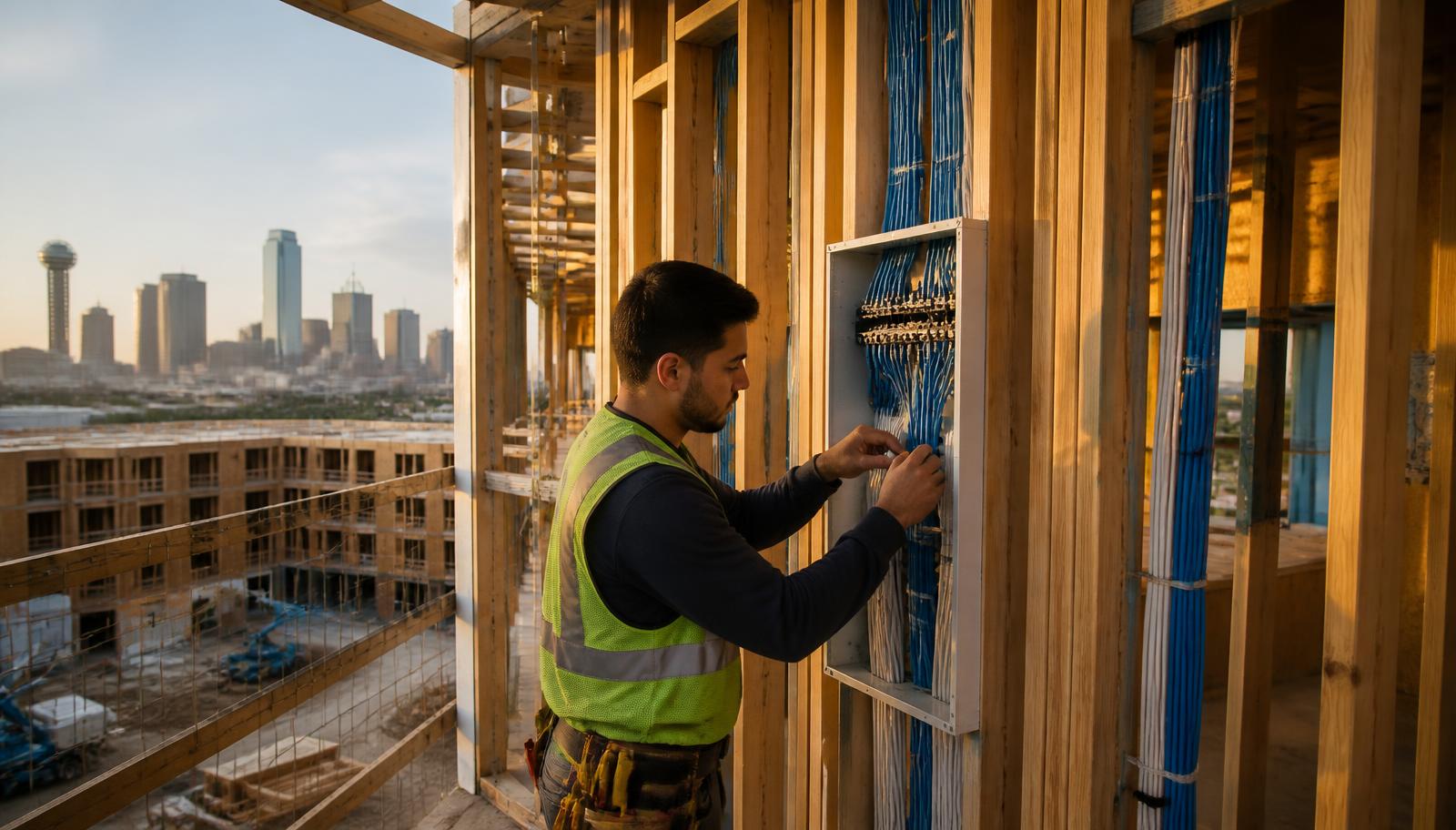
Low-Voltage Cost Per Door: A 2026 Budget Guide for Texas Multifamily Developers
"What should I carry per door for low voltage?" It is the first question every Texas multifamily developer asks — usually during schematic design, when the technology scope is still one line on a budget sheet. Get the number wrong and Division 27/28 becomes the change-order line that eats your contingency in the last 90 days of the job. This guide breaks down how EIG PRO builds a realistic per-door low-voltage budget for wrap, podium, mid-rise, high-rise, and build-to-rent communities across Dallas–Fort Worth, Houston, Austin, and San Antonio.
Why "Cost Per Door" Is the Wrong Question by Itself
Per-door pricing is a useful sanity check, not a scope. Two 250-unit communities three miles apart in Frisco can differ by more than 2x per door depending on five variables:
- Build type. A garden-style wrap with short horizontal runs prices very differently from a Type I high-rise with riser-heavy vertical distribution. See our breakdown of multifamily build types.
- Unit device count. Are you carrying two data drops and one TV location per unit, or smart locks, thermostats, leak sensors, in-unit Wi-Fi APs, and a video intercom endpoint?
- Amenity load. Clubhouse AV, fitness mirrors, pool area sound, digital signage, and a leasing-office conference room can add six figures that never show up in a per-door average.
- Property-wide systems. Access control, gates, IP camera counts, managed Wi-Fi, and the MDF/IDF backbone are property costs, not unit costs.
- Who owns what. Locksets, thermostats, ISP-furnished equipment, and appliance-integrated devices frequently move between the GC, the owner, and the technology vendor. Every one of those transfers changes the number.
The right question is: what is my fully-loaded technology budget, split between in-unit, common area, and property infrastructure?
The Three Budget Buckets
1. In-Unit Low Voltage
This is the most predictable bucket because it scales linearly with unit count. A typical Texas Class A unit package includes structured cabling to each bedroom and living area, a media/enclosure panel, TV locations, a video intercom or smart-entry endpoint, and increasingly an in-unit wireless access point supporting a property-wide managed network. Our structured cabling team standardizes the in-unit rough-in so the trim crew can move a floor a day.
2. Common Area & Amenity Technology
Clubhouse, leasing office, fitness, pool, co-working, and package rooms. This bucket is driven by design intent, not unit count, and it is where owner expectations most often outrun the original budget. Distributed audio, video walls, and conferencing all live here — see our approach to commercial AV.
3. Property Infrastructure
MDF and IDF build-out, backbone fiber, horizontal pathways, networking and Wi-Fi, access control and surveillance, gate integration, elevator and pool code phones, and area-of-refuge systems. Texas code requirements for pool phones, elevator phones, and area of refuge are non-negotiable, and they are routinely missed at buyout.
A Budgeting Framework That Survives Buyout
Instead of a single number, carry a matrix. On a 250-unit podium project in DFW, we would ask a developer to budget in this order:
- Lock the unit device schedule first. One page. Every device, every unit type, who furnishes it, who installs it.
- Count the property devices. Cameras, readers, APs, intercom stations, gates, code phones. Device counts drive material, labor, head-end, and licensing.
- Add recurring cost lines separately. Cloud access control, managed Wi-Fi, camera storage, and smart-home platform fees are operating expenses, not construction cost. Owners hate discovering them at turnover.
- Carry pathway and coordination. Sleeves, J-hooks, firestopping, and MEPT coordination hours. Read why the T in MEPT deserves its own coordination seat.
- Reserve 5–8% design contingency until the technology scope is CD-level. Design-development budgets built on schematic drawings should never be treated as hard numbers.
The Five Costliest Budget Misses We See in Texas
- Smart lock ownership shifting mid-bid. Whether the GC, the owner, or the low-voltage contractor furnishes locksets can swing a package by six figures on a 250-unit deal.
- ISP demarc assumptions. Bulk-internet agreements signed after buyout change riser counts, MDF space, and who pays for in-unit APs.
- Amenity AV designed by rendering. If the interior designer showed a video wall, someone has to pay for the structure, power, cooling, and control system behind it.
- Code-required phones left out. Pool, elevator, and area-of-refuge systems are code, not options. See our Texas code compliance guide.
- No allowance for turnover support. Lease-up punch, unit-by-unit device commissioning, and property staff training take real hours.
Metro-Level Differences Across Texas
Labor availability, permitting cadence, and prevailing unit finishes all shift the number by market. High-density Austin and Houston high-rise work carries more vertical distribution and more union-adjacent coordination; DFW suburban wrap and build-to-rent product carries longer horizontal runs and more site pathway. We build and price work in each of these markets:
- Dallas low-voltage contractor and Dallas structured cabling
- Fort Worth, Plano, and Frisco
- Houston and the greater Gulf Coast corridor
- See every market on our Texas service area map
How to Get a Real Number Instead of an Average
Averages are for board decks. For a real budget, send us the unit mix, the device schedule (or your best guess at it), the amenity program, and any ISP or smart-home platform already under LOI. We return a scoped, line-item budget with clear inclusions, exclusions, and owner-furnished assumptions — the same format we use on active Texas projects.
If you are earlier than that, start with our resource library and the low-voltage glossary so your team and your GC are using the same vocabulary before pricing starts.
Bottom Line
A defensible low-voltage budget in 2026 is built from three buckets — in-unit, amenity, and property infrastructure — plus a clear device schedule and an honest split of who furnishes what. Developers who lock those four items before buyout almost never see a technology change order that matters. Those who carry a single per-door number usually do.
Ready to price your next Texas community? Contact EIG PRO for a scoped Division 27/28 budget, or submit drawings directly for a formal proposal.
Stay Updated
Get the latest insights on smart building technology, security systems, and industry trends delivered to your inbox.
Related security services
Explore how EIG PRO designs, installs and services these systems across Texas.
Security & Surveillance Systems
Access control, CCTV, intercom and monitoring designed and installed by one licensed contractor.
Learn moreAccess Control in Dallas
Card readers, mobile credentials and door hardware coordination for Dallas properties.
Learn moreSecurity Systems in Fort Worth
CCTV, LPR and gate integration for Fort Worth commercial and mixed-use buildings.
Learn moreSecurity Systems in Plano
Multifamily access control, package room and amenity surveillance across Plano.
Learn moreStructured Cabling
The Category and fiber backbone every camera and reader depends on.
Learn moreNetwork Infrastructure
PoE switching, VLANs and UPS sizing so your security system stays online.
Learn moreContinue Reading
Explore more insights and expertise from EIG PRO
How to Contact EIG PRO Support: Help Desk, Project Support & Service Plans
Learn how to contact EIG PRO support, use our help desk, and get help before design, during installation, and after turnover. Compare Monitoring, Protection, and Full Protection plans.
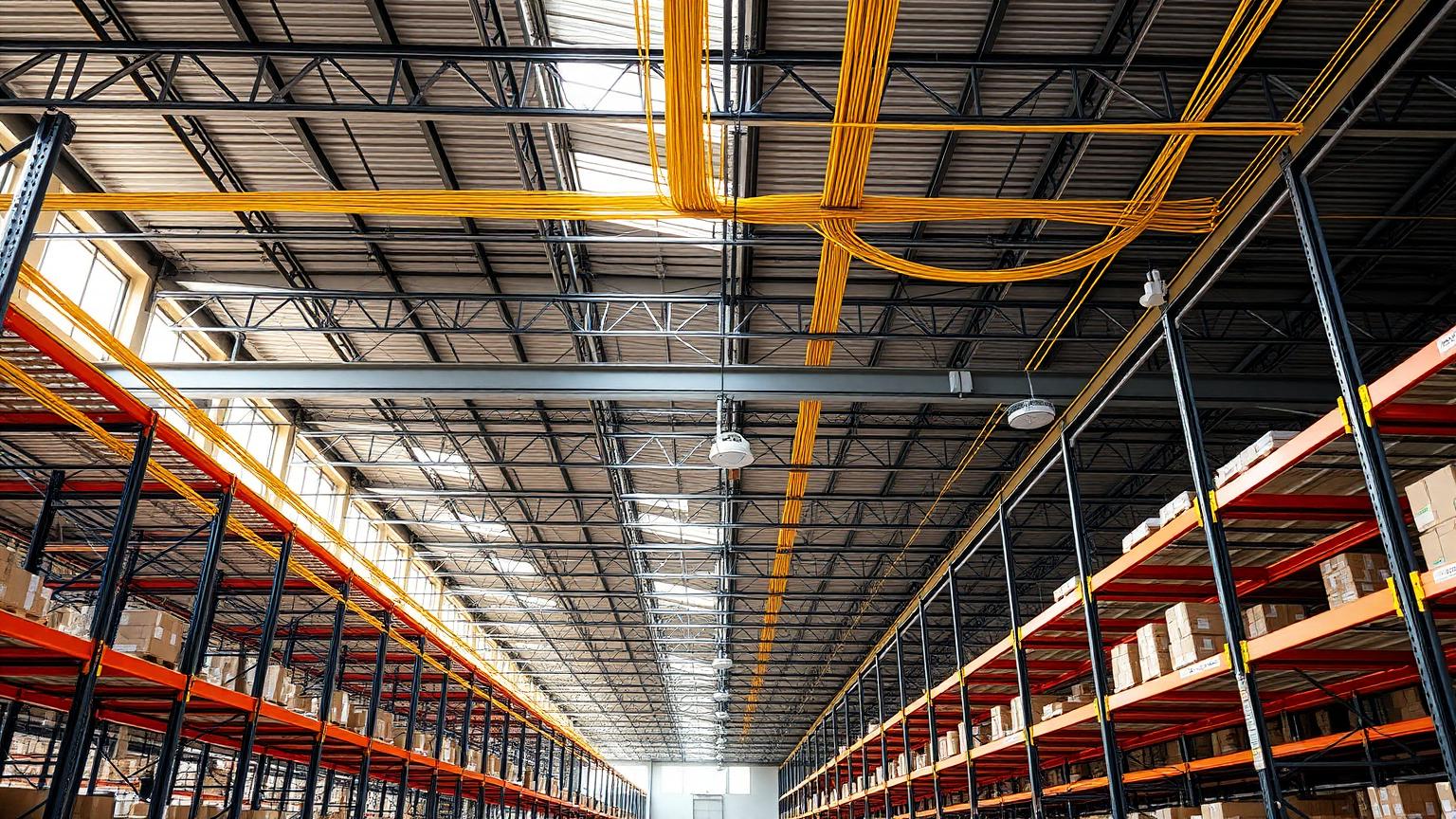
Warehouse & Distribution Center Technology in DFW: Fiber, Wi-Fi, and CCTV That Scale
A practical guide to low-voltage infrastructure for DFW warehouses and distribution centers — fiber backbones, warehouse Wi-Fi design, CCTV coverage, and the compliance layer national tenants require.

The Construction Tech Stack Behind EIG PRO: Procore, BuildingConnected & the Tools That Deliver Projects On Time
Inside the construction project management software, bid tools, and compliance platforms EIG PRO uses — from Procore and BuildingConnected to Textura, Bluebeam, Elation, and QuickBooks.
Get a free security consultation
Access control, CCTV and networking guidance from a licensed Texas low-voltage contractor. No pressure, no obligation.