
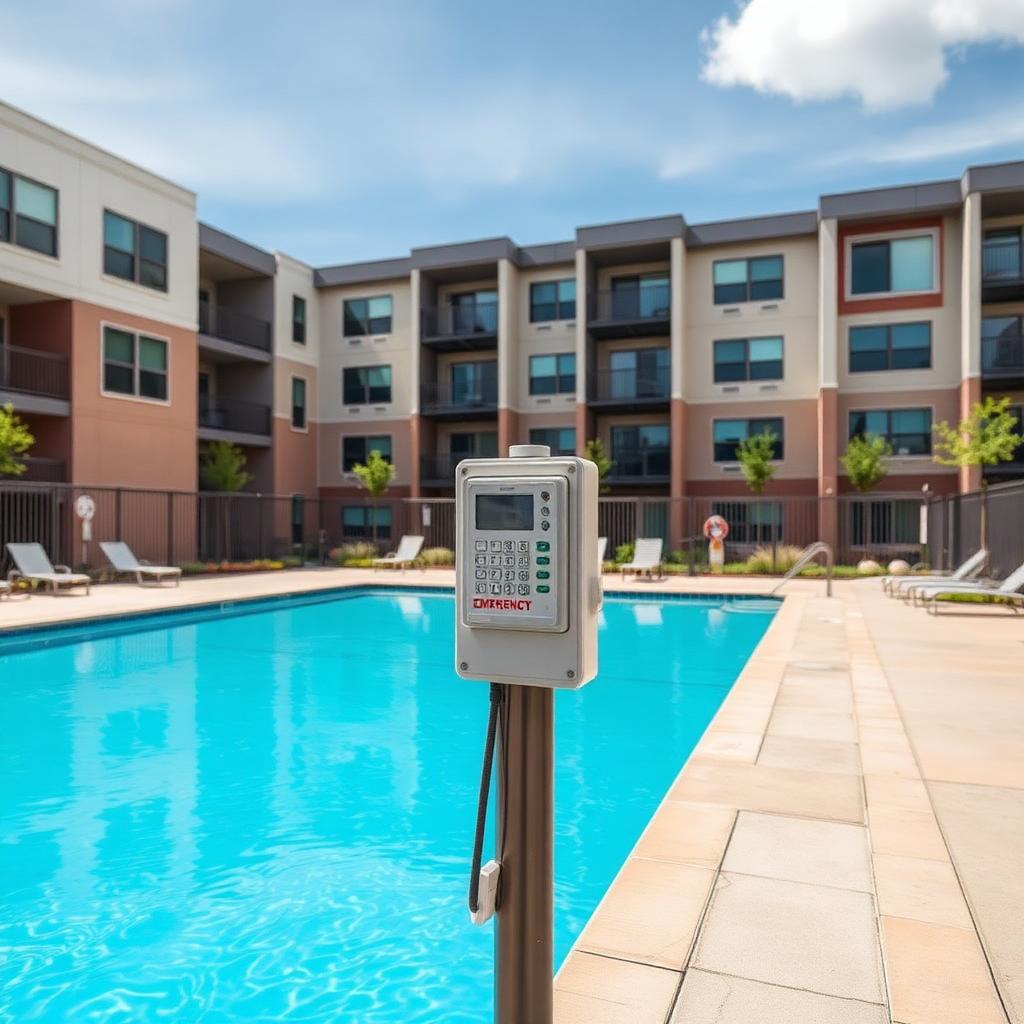
Texas Pool Phone, Elevator Phone & Area of Refuge Code: What Property Owners Need to Know
Understanding Texas Emergency Communication Requirements
If you own or manage a commercial property, multifamily community, or hospitality venue in Texas, you need to understand three critical sets of emergency communication codes: the Texas Pool Phone Law, the Texas Elevator Phone Code, and Area of Refuge two-way communication requirements. Non-compliance isn't just a code violation — it's a serious liability risk that could endanger lives.
At EIG PRO, we specialize in the low voltage infrastructure, structured cabling, and telecom systems that make these emergency communication solutions work reliably. Here's what you need to know.
Texas Pool Phone Law
The Texas pool phone requirements are governed by Texas Administrative Code, Title 25 Health Services, Part 1, Chapter 265, Subchapter L — Standards for Public Swimming Pools and Spas, specifically Rule §265.190 (Safety Features for Pools and Spas). These rules went into effect January 1, 2023.
Key Requirements
Every public pool or spa in Texas must have at least one emergency communication device that meets all of the following criteria:
- Capable of immediately summoning emergency services (911 or equivalent)
- Readily accessible and located within 200 feet of the water
- Functioning at all times the pool or spa is open for use
- For seasonal pools, the device must be operational 24 hours a day during the entire season
- Clear operating instructions must be posted
Device Specifications
The Texas code allows several types of compliant emergency devices:
- Fixed-location telephone — Must be visible, unobstructed, and clearly identified. Must be capable of dialing 911 or an emergency service.
- Emergency monitoring contact device — When activated, must connect directly to a 24-hour monitoring service, 911 dispatch, or emergency medical services.
- Alternative communication system — May contact an on-site office only if the pool is in a remote area with limited EMS response times and on-site employees are trained/certified to perform emergency medical intervention.
- Dedicated cell phone — Permitted if mounted in the pool yard for public use, labeled as the emergency phone, activated by a service provider, connected to a permanent power supply, and capable of reaching 911.
Critical Restrictions
- The phone or device must not be answered by an on-site office (except under the remote area exception noted above).
- A sign must be posted above the device displaying the precise location of the pool (address, building number, GPS coordinates) in letters at least 1 inch in height.
What This Means for Your Property
For multifamily properties, hotels, and commercial venues across Texas, this code directly impacts your pool area infrastructure. You need:
- Properly rated outdoor telecom cabling and conduit
- Weatherproof emergency phone enclosures
- Reliable network or cellular connectivity at the pool location
- Signage that meets the 1-inch letter height requirement
- Regular testing and maintenance protocols
Texas Elevator Phone Code
Texas follows the ASME A17.1/CSA B-44 2019 Safety Code for Elevators and Escalators for elevator emergency communication requirements. According to Kings III, a leading authority on emergency communication compliance, Texas's adoption of the 2019 code means the following requirements are in effect:
Required Elevator Communication Features
| Requirement | Status |
|---|---|
| Two-way communication between elevator and authorized personnel | ✅ Required |
| On-site communications if over 60 ft of travel | ✅ Required |
| Communication between elevator and remote machine/control rooms | ✅ Required |
| Answer by live authorized personnel (no automated answering) | ✅ Required |
| Communication capability for on-site authorized/emergency personnel | ✅ Required |
| On-site monitoring if staffed 24/7 by authorized personnel | ✅ Required |
| Location identification on demand to authorized personnel | ✅ Required |
| Location identification without voice communication (ADA compliance) | ✅ Required |
| Hands-free devices only (handsets not approved) | ✅ Required |
| Automatic answer when calling into elevator | ✅ Required |
| Automatic redirect if no answer on-site | ✅ Required |
| Off-site communication shall not interfere with on-site communications | ✅ Required |
| Local telephone line status monitoring and local alert | ✅ Required |
| Two-way message display in cab for hearing/speech impaired* | ✅ Required |
| Means for authorized personnel to view video of passengers* | ✅ Required |
| Means to change cab message indicating help is on-site (over 60 ft travel)* | ✅ Required |
Items marked with an asterisk are newer requirements introduced in the 2019/2022 code updates.
The Low Voltage Infrastructure Behind Compliance
Meeting these elevator code requirements involves significant telecom and low voltage work:
- Structured cabling to each elevator shaft and machine room
- Hands-free intercom and emergency phone systems (no handsets per code)
- ADA-compliant visual communication displays for hearing/speech impaired passengers
- Video surveillance integration allowing authorized personnel to view the cab
- Automatic call routing with failover to off-site monitoring when on-site staff doesn't answer
- Line monitoring systems that alert when communication lines go down
- Cellular backup solutions as traditional copper phone lines are phased out
Texas Area of Refuge Requirements
In addition to pool and elevator codes, Texas enforces area of refuge communication requirements that impact multi-story commercial buildings. An area of refuge is a designated safe space within a building where people who cannot use stairways can wait for assistance during an emergency evacuation. According to Cornell Communications, Texas follows the IBC 2012, NFPA 72 (2019), and ADA 2010 standards for area of refuge systems.
What Is an Area of Refuge?
An area of refuge is a floor area within a building that provides a temporary safe space for occupants — particularly those with mobility impairments — who cannot use stairs during an emergency. These areas must be equipped with a two-way communication system so occupants can alert emergency responders to their location.
IBC 2012 Requirements
According to IBC Section 1009, accessible means of egress require an area of refuge in all new multi-story commercial buildings and additions/renovations considered new construction. The two-way communication system must:
- Provide communication between each required area of refuge location and the fire command center or a central control location approved by the fire department
- Have a timed automatic telephone dial-out capability that provides two-way communication with an approved supervising station or 9-1-1 (if the central control point is not constantly attended)
- Include both audible and visible signals
Exemptions: Buildings with supervised automatic sprinkler systems throughout are exempt from the physical refuge area requirement, but the two-way communication system is still required. Other exemptions include assisted living facilities, healthcare facilities, prisons, residential psychiatric facilities, and drug rehab facilities.
NFPA 72 (2019) Two-Way Emergency Communication Requirements
The NFPA 72 code adds detailed technical specifications for area of refuge communication systems:
- Remote communication stations must provide hands-free, two-way communication
- Must provide audible and visual signals to indicate communication has occurred
- Must identify the specific location sending the signal to the receiver
- The master control unit must be installed in a central control point within the building
- If the central control point is not constantly attended, the system must have a timed automatic communications capability to connect to an off-site constantly attended monitoring location
- All pathways between remote stations and the master control unit must be monitored for integrity
Pathway Survivability Requirements
NFPA 72 specifies survivability levels for wired emergency communication systems:
- Level 1 — For buildings fully protected by automatic sprinklers (NFPA 13), with pathways protected by metal raceways or metal armored cables
- Level 2 — 2-hour fire-rated circuit integrity cable, 2-hour fire-rated enclosure, or performance alternatives approved by the authority having jurisdiction
- Level 3 — For fully sprinklered buildings: 2-hour fire-rated cable systems, circuit integrity cable, fire-rated enclosures, or approved performance alternatives
ADA 2010 Requirements
ADA Section 207 requires accessible means of egress with areas of refuge in all multi-story commercial buildings. This ensures that people with disabilities have equal access to safe evacuation routes and can communicate with emergency responders.
Area of Refuge Signage Requirements
Texas building code (IBC 1011.1) requires areas of refuge to be clearly marked:
- Doors providing access must be identified with a sign stating: "AREA OF REFUGE"
- Doors to exterior assisted rescue areas must state: "EXTERIOR AREA FOR ASSISTED RESCUE"
- Signage must comply with ICC A117.1 requirements
- Signage must be illuminated where exit sign illumination is required
The Low Voltage Work Behind Area of Refuge Systems
Implementing a compliant area of refuge system requires specialized low voltage infrastructure:
- Fire-rated structured cabling meeting NFPA pathway survivability requirements
- Two-way intercom stations at each designated refuge area
- Master control units at the fire command center
- Automatic dial-out systems to monitoring stations or 9-1-1
- ADA-compliant visual and audible alert devices
- Pathway integrity monitoring systems
- Code-compliant signage with illumination
How EIG PRO Helps You Stay Compliant
As a full-service low voltage contractor serving Texas and Oklahoma, EIG PRO provides end-to-end solutions for emergency communication compliance:
Pool Emergency Phone Systems
- Site surveys to determine optimal phone placement within the 200-foot requirement
- Weatherproof emergency phone installation with proper cabling and power
- Cellular-based solutions for pools without existing landline infrastructure
- Code-compliant signage with precise location information
- Ongoing maintenance and testing programs
Elevator Emergency Communication Systems
- ASME A17.1-compliant hands-free intercom installation
- ADA-compliant visual display systems
- Video surveillance integration for elevator cabs
- Automatic call routing to 24-hour monitoring services
- Cellular conversion for buildings transitioning away from copper lines
- Line monitoring with automatic alert systems
Area of Refuge Communication Systems
- Two-way intercom installation at all designated refuge areas
- Fire-rated cabling meeting NFPA pathway survivability requirements
- Master control unit installation at fire command centers
- Automatic dial-out to approved monitoring stations or 9-1-1
- ADA-compliant audible and visual signal devices
- Pathway integrity monitoring
- Code-compliant signage with illumination
Related Services
- Structured Cabling — The backbone infrastructure for all emergency communication systems
- Security Systems — Integrated video surveillance for elevator and pool monitoring
- Networking — Reliable connectivity for cellular and IP-based emergency devices
- Commercial AV — Intercom and paging systems for property-wide communication
Don't Wait for an Inspection
Texas health inspectors, elevator safety inspectors, and fire marshals actively enforce these codes. Fines, operational shutdowns, and — most importantly — liability in the event of an emergency make compliance non-negotiable.
Whether you're building a new multifamily community, renovating a hotel, or upgrading an existing commercial property, EIG PRO can design and install compliant emergency communication systems — from pool phones and elevator intercoms to area of refuge two-way communication — from the ground up.
Request a consultation to discuss your pool phone, elevator phone, or area of refuge compliance needs, or call us at 877-344-7764.
Sources: Texas Administrative Code, Title 25, Chapter 265, §265.190; Kings III Emergency Communications — State Pool and Elevator Laws; Cornell Communications — Area of Refuge Requirements in Texas; ASME A17.1/CSA B-44 2019 Safety Code for Elevators and Escalators; IBC 2012; NFPA 72 (2019); ADA 2010.
Stay Updated
Get the latest insights on smart building technology, security systems, and industry trends delivered to your inbox.
Related services
Explore the services behind this work.
Commercial AV
Conference rooms, digital signage and amenity audio across Texas.
Learn moreStructured Cabling
Category and fiber infrastructure built to standard and documented.
Learn moreSecurity & Surveillance
Access control, CCTV and intercom for commercial and multifamily.
Learn moreNetwork Infrastructure
Switching, Wi-Fi and MDF/IDF design that holds up under load.
Learn moreGet a free security consultation
Access control, CCTV and networking guidance from a licensed Texas low-voltage contractor. No pressure, no obligation.