
What Is Structured Cabling? Components, Standards & Costs for Texas Buildings
Structured cabling is the standardized cabling infrastructure — organized into defined subsystems, built to ANSI/TIA-568, and labeled so anyone can trace it — that supports your building's network, Wi-Fi, security cameras, access control, and AV. Instead of ad hoc point-to-point runs, every cable lands on a patch panel in a managed closet, on a schedule someone can actually service.
If you are developing, building, or owning commercial or multifamily property in Texas, this guide explains what a structured cabling system actually includes, the standards that govern it, and how to budget for one without guessing. EIG PRO designs and installs structured cabling for projects across Texas and Oklahoma — the practices below are the same ones we apply in the field every week.
What Is Structured Cabling, in Plain English?
Structured cabling is a building-wide cabling system: standard cable categories and fiber, standard pathways, standard closets, and standard labeling — organized so that any device anywhere in the building can connect back to a central head-end predictably.
The opposite is point-to-point wiring: every system (security, phones, Wi-Fi, cameras) pulls its own cable straight from its own equipment with no shared infrastructure. It works until it doesn't — then nobody can trace a dead port, adding a device means tearing open walls, and manufacturers won't stand behind a messy install.
A structured system gives you three things point-to-point never will:
- Serviceability. A labeled, certified, standards-compliant port can be traced in minutes, not hours.
- Scalability. New systems ride the existing horizontal cabling instead of triggering new walls-opened work.
- Warranty integrity. Manufacturer channel warranties on premium systems only stay valid when a single-manufacturer channel is installed and tested to standard.
The Six Components of a Structured Cabling System
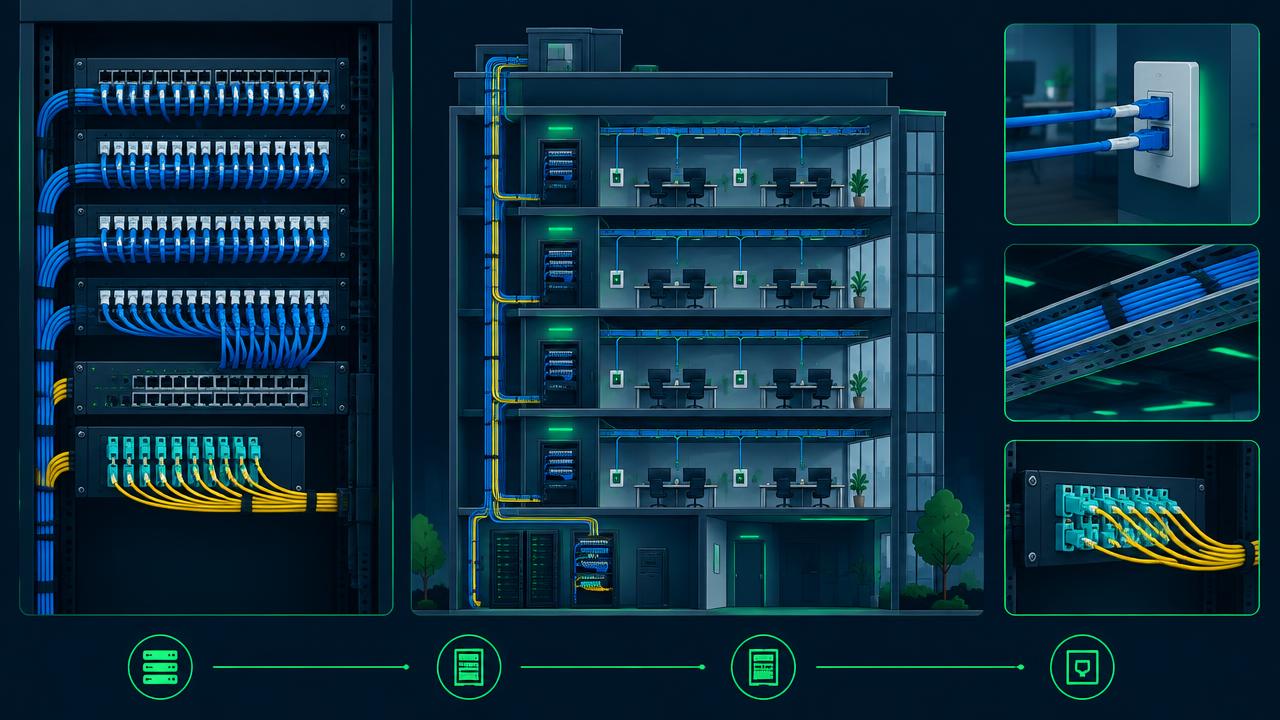
TIA-568 divides a structured cabling system into six subsystems. If a contractor talks about cabling without these, they are selling cable, not a system.
1. Entrance Facility (the Demarc)
Where the outside plant — ISP fiber, telephone entry, antenna feeds — enters the building and meets your inside cabling. The demarcation point defines where the service provider's responsibility ends and yours begins. Getting this wrong delays service turn-up on nearly every project.
2. Equipment Room (the MDF)
The Main Distribution Frame is the building's core: core switching, ISP handoff, head-end equipment for cameras and access control, and the origin of every backbone run. Sized for today's gear plus 20 years of growth — not just whatever fits in the current electrical room.
3. Backbone Cabling
The vertical and inter-floor cabling that connects every telecom room back to the MDF: typically single-mode or OM4 multimode fiber, sized with spare pairs because fiber is cheap relative to re-pulling it through a finished building.
4. Telecommunications Rooms (IDFs)
The Intermediate Distribution Frames — floor-level or zone-level closets that house switches and patch panels for the devices around them. Placement is governed by the 90-meter horizontal rule: if an outlet would exceed it, you need another IDF. A wide floor plate can need two or three IDFs on the same level.
5. Horizontal Cabling
The run from each IDF to every wall outlet: Cat6 or Cat6A in commercial and multifamily, on TIA-568's 90-meter permanent link plus 10 meters of patch cord. Pathways (J-hooks, cable tray, sleeves), plenum-rated (CMP) cable where code requires it, and separation from electrical all live in this layer. See our Cat6 vs Cat6A guidance for where each belongs.
6. Work Area
Everything at the outlet end: the faceplates, the connectors, and the 90-degree drop to the desk, camera, access reader, or access point. Small, but it's what users and devices actually touch — and it's where cheap components quietly undo a good backbone.
The Standards That Govern Structured Cabling
- ANSI/TIA-568 — the family of standards defining topology, cable performance categories, and testing. See our TIA-568 explainer.
- ANSI/TIA-606 — labeling and administration. A building without consistent labeling isn't serviceable no matter how good the cable is.
- NEC (Article 800 and related articles) — fire rating, plenum vs riser cable types, support and separation requirements.
- BICSI best practices — the installation craft standards: bend radius, dress, grounding, and pathway discipline.
Certification testing ties it together: every permanent link is field-tested to its category, and the test results are delivered with the closeout package. That documentation is what makes a cabling system an asset instead of a mystery.
What Uses Structured Cabling?
Almost every low-voltage system in a modern building:
- Network and Wi-Fi — access points and switches are only as good as the cabling feeding them. See network infrastructure.
- Security — IP cameras, access control readers, and intercoms are PoE devices riding the same horizontal cabling.
- AV — conference rooms, digital signage, and amenity systems increasingly run over the same network.
- Building systems — smart thermostats, leak sensors, lighting controls, and elevator and pool code phones.
That convergence is the whole argument for structured cabling: one infrastructure, one standard, one team accountable for it.
How Much Does Structured Cabling Cost?
The honest answer: it depends on build type, device count, and how much property infrastructure (MDF/IDF build-out, backbone, cameras, readers) is in scope — which is why a per-door average alone will mislead you. Two 250-unit communities in the same suburb can differ by more than 2x per door.
The right approach is a fully-loaded budget split three ways: in-unit devices, common-area and amenity technology, and property infrastructure. We walk through that framework in detail in our low-voltage cost-per-door guide for Texas multifamily, and our glossary entry on cost per door covers the math. For a number attached to your actual floor plans, send us your bid set — takeoffs are free.
Frequently Asked Questions
What is structured cabling in simple terms?
It's a building-wide cabling system built to a standard: every cable lands on a labeled patch panel in a managed closet, follows a defined pathway, and is tested and documented — instead of each system running its own ad hoc point-to-point wiring.
What are the six components of a structured cabling system?
Per TIA-568: the entrance facility, the equipment room (MDF), backbone cabling, telecommunications rooms (IDFs), horizontal cabling, and the work area at the outlet end.
How far can Cat6 cable run?
100 meters total under TIA-568 — a 90-meter permanent link plus up to 10 meters of patch cords. Beyond that, you need fiber or an additional IDF.
What's the difference between an MDF and an IDF?
The MDF is the single main distribution point for the building — core switch and service provider demarc. IDFs are the satellite closets serving a floor or zone, connected back to the MDF over backbone fiber.
How should I budget for structured cabling on a Texas project?
Split the budget three ways — in-unit, common area/amenity, and property infrastructure — and carry pathway, coordination, and a 5–8% design contingency until the technology scope is CD-level. Our cost-per-door guide walks through the full framework.
Does structured cabling have to be certified?
Every horizontal run should be field-tested to its category, and the results delivered at closeout. Certification is also what preserves manufacturer warranty coverage — including extended channel warranties on select premium systems when a single-manufacturer channel is specified.
Planning a Project in Texas?
EIG PRO is a licensed Texas low-voltage contractor (TX License #B28642601) designing and installing structured cabling, networking, and security systems across Dallas–Fort Worth, Houston, Austin, and beyond. Request a quote or send your bid set — we'll return a takeoff built to standard, with the documentation to prove it.
Stay Updated
Get the latest insights on smart building technology, security systems, and industry trends delivered to your inbox.
Related services
Explore the services behind this work.
Commercial AV
Conference rooms, digital signage and amenity audio across Texas.
Learn moreStructured Cabling
Category and fiber infrastructure built to standard and documented.
Learn moreSecurity & Surveillance
Access control, CCTV and intercom for commercial and multifamily.
Learn moreNetwork Infrastructure
Switching, Wi-Fi and MDF/IDF design that holds up under load.
Learn moreContinue Reading
Explore more insights and expertise from EIG PRO
Commercial Networking Solutions in Oklahoma City
Professional commercial networking solutions for Oklahoma City businesses. Enterprise WiFi, structured cabling, switching, fiber, and network security installation.
What is a router, wireless access point (WAP), & a network switch?
Learn the differences between routers, wireless access points, and network switches. Essential networking knowledge for businesses...
Get a free security consultation
Access control, CCTV and networking guidance from a licensed Texas low-voltage contractor. No pressure, no obligation.