
Structured Cabling in Dallas: The Multifamily Developer’s Low-Voltage Playbook (2026)
Structured Cabling in Dallas: The Multifamily Developer's Low-Voltage Playbook (2026)
If you're putting steel in the ground anywhere from Frisco to Fort Worth this cycle, the cheapest mistake you can make is treating low-voltage as an afterthought. DFW has become one of the most competitive multifamily lease-up markets in the country, and renters now decide whether to renew based on how fast their WiFi works on move-in day — not how nice the dog wash looks.
This is the playbook we use on every multifamily project we wire in Dallas–Fort Worth: what structured cabling actually covers, what the DFW market specifically demands, and what to look for in a low-voltage bid before you sign it.
What "structured cabling" really means on a multifamily site
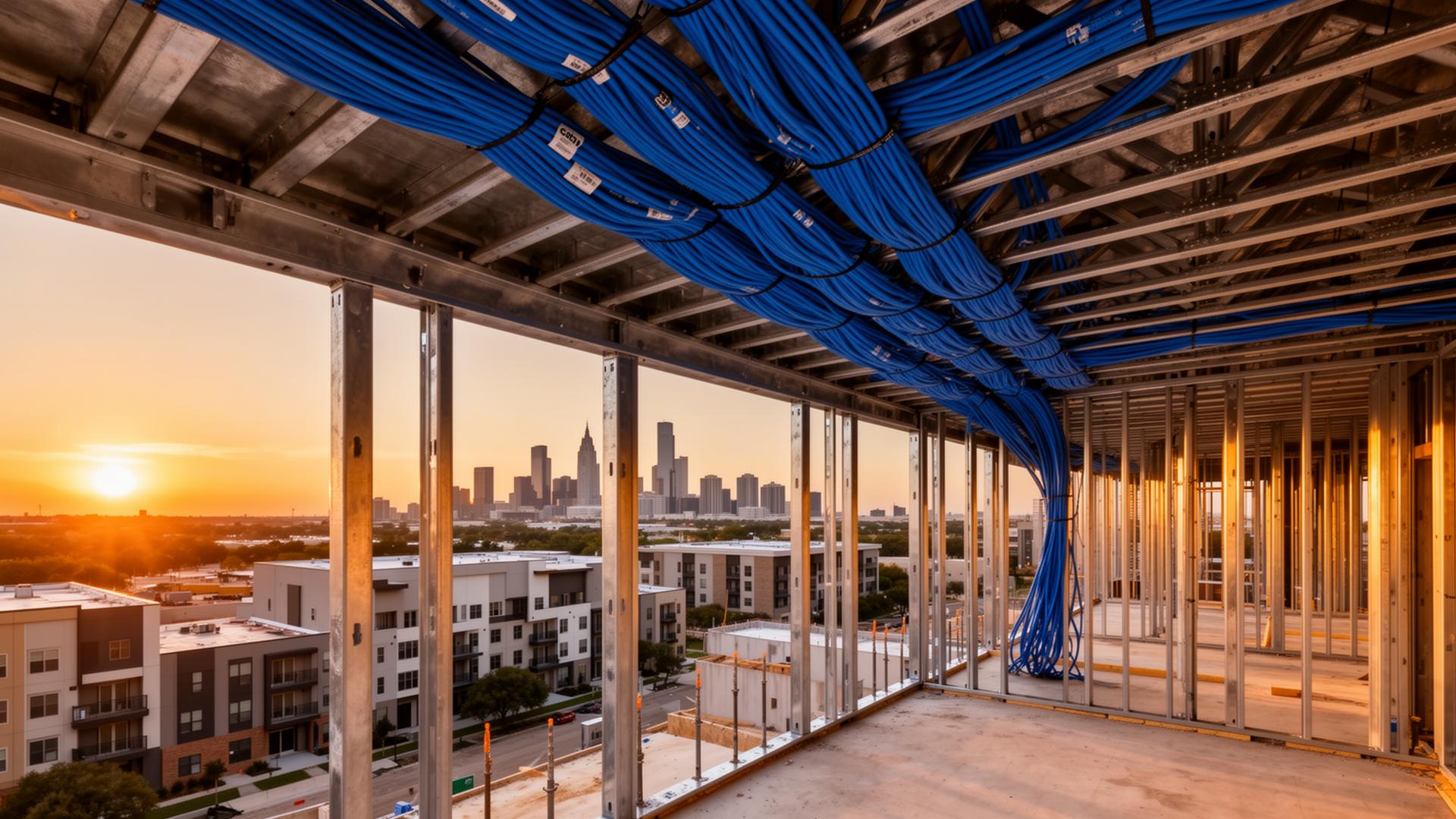
Structured cabling is the standards-based wiring backbone that carries every data, voice, video, and IP-device signal in the building. On a multifamily project that means:
- Cat6 or Cat6A horizontal runs to every voice/data outlet, WAP, camera, access reader, and intrusion device
- Single-mode or OM4 fiber backbone between the MDF and each IDF
- A clear MDF/IDF hierarchy sized to your unit count and building footprint
- Grounding, bonding, pathways, and firestopping built to BICSI and TIA-568 / TIA-569 / TIA-570 standards
The "structured" part is the discipline. Anyone can pull cable. Doing it so it tests clean, certifies clean enough for extended manufacturer warranties, and survives an AHJ inspection is what separates a real low-voltage contractor from a handyman with a spool of Cat6.
The DFW market reality
DFW is not a generic Sunbelt market. A few things shape every structured cabling job we run here:
- Attic heat. Plenum-rated cable matters more in North Texas than almost anywhere else. We routinely see attic temps north of 140°F in July. Spec jacketed cable rated for the actual ambient, not the catalog minimum.
- AHJ patchwork. Dallas, Fort Worth, Plano, Frisco, Arlington, McKinney, Allen, and Denton each inspect a little differently. Sleeve sizing, riser firestop, and low-voltage permitting trip up out-of-state GCs on a regular basis. The right local contractor knows which inspectors want what.
- Texas state license. Anyone touching access control, intrusion, or fire-adjacent low-voltage on your site needs a PSB (B-license). EIG PRO carries TX License #B28642601 — verify it on any bid that crosses your desk.
- Pool phones. Texas Health & Safety Code requires a hardwired emergency phone at every commercial pool. It's not optional and it's not cellular. Build it into the rough-in budget.
If you're new to the metroplex, see our Dallas–Fort Worth multifamily overview for how this market differs from Austin, Houston, or OKC.
Per-unit scope: what should be in every apartment
This is where bids vary the most. A "complete" multifamily low-voltage scope for a 2026 build-to-rent or mid-rise unit typically includes:
| Drop | Quantity per unit | Cable |
|---|---|---|
| Voice/data outlets | 2–4 (living, primary bedroom, optional secondary BR / office) | Cat6 |
| WAP drop | 1 per unit (ceiling, central) | Cat6A |
| Smart deadbolt | 1 front entry, sometimes patio | Low-voltage power + Z-Wave/Zigbee gateway |
| Smart thermostat | 1 per HVAC zone | 18/8 stat wire |
| Leak sensors | Under sinks + at water heater | Wireless or 22/2 |
| Door/window contacts | Front door + accessible patio/window | 22/4 |
| TV pre-wire | Living + primary BR | Coax + Cat6 |
| AV pre-wire (optional) | Living | In-wall speaker wire + HDMI conduit |
Budget per-unit for low-voltage on a market-rate DFW garden or mid-rise typically lands somewhere between $1,400 and $2,800 per door depending on smart-home stack, WAP density, and AV pre-wire. Luxury and high-rise can run double that. If a bid comes in at $600 per door, something is missing.
Common areas and amenities — where Texas code bites
Common-area low-voltage is what makes the leasing tour feel premium. It's also where compliance gets real:
- Leasing office — VoIP, dual-monitor data drops at every desk, conference room AV, package room camera, video doorbell
- Clubhouse / lounge — Distributed audio with properly licensed commercial music, 4K displays, video conferencing for resident remote-work amenity
- Fitness center — TV array, distributed audio, mirror-mount cameras, equipment-area WAPs (gyms eat WiFi)
- Pool — Hardwired pool phone (Texas H&S code), perimeter cameras, gate access readers, ambient music with proper licensing
- Mail/package room — Smart locker integration, 24/7 camera, door access reader
- Parking & garages — License plate recognition cameras at entries, ALPR at controlled gates, hardened WAPs for staff coverage
- Stairwells & corridors — Area-of-rescue communication where ADA + IBC require it, IP cameras, access control on stair doors
Miss the pool phone or the area-of-refuge intercoms and you'll fail final inspection. We build both into every multifamily scope by default.
MDF/IDF design: mid-rise vs garden-style
The 90-meter horizontal channel limit in TIA-568 is the single most ignored number in low-voltage design. It governs how many IDFs you need, and it's why your structured cabling contractor needs to be involved during design development — not after the GC has framed the building.
Garden-style (2–4 story, multiple buildings):
- One MDF in the leasing/clubhouse building
- One IDF per residential building, fiber-fed from MDF
- Underground fiber in conduit between buildings — never aerial in DFW, the storms will get you
Mid-rise (5–8 story, single building):
- One MDF at grade or basement
- One IDF per floor, or one per 2 floors with strategic placement
- Riser fiber + Cat6A trunking up a dedicated low-voltage shaft
- Firestop every penetration. Every. Single. One.
High-rise & podium:
- Often two MDFs (north/south or A/B side) for redundancy
- IDF every floor minimum, sometimes one per wing
- Diverse fiber paths if the owner wants real resilience
Sequencing with the GC
The fastest way to blow a low-voltage budget is to bring the contractor on after framing. Here's the sequence that actually works:
- Schematic design — Low-voltage consultant or design-build contractor reviews unit mix and amenity program
- Design development — MDF/IDF locations confirmed, sleeve schedule issued to architect and structural
- Construction documents — Cable schedules, device locations, and headend equipment specified
- Pre-construction — Rough-in dates locked into the master schedule
- Rough-in — Cable, conduit, j-boxes, and sleeves installed ahead of insulation/drywall
- Trim — Devices, faceplates, headend gear, programming
- Test & certify — Every drop certified, paperwork to owner
- Punch & turnover — Resident-facing systems demonstrated and documented
If your low-voltage bid doesn't mention preconstruction coordination, it's not a real bid.
The 2026 smart-apartment stack
Renter expectations in DFW have moved. A "luxury" 2024 spec is now table stakes:
- Smart deadbolts at every front entry — most common platforms are Yale, Schlage Encode, or Salto/Brivo for integrated access
- Smart thermostats integrated to property management — Ecobee, Honeywell, or building-wide platforms like Entrata or RealPage
- Leak detection — insurance carriers are starting to require it
- Building-wide WiFi vs per-unit ISP — managed WiFi is a profit center now; the structured cabling decisions you make today determine whether you can pivot to it later
- Package management integration — Luxer, Parcel Pending, Amazon Hub — all want a data drop and a camera
- EV charging head-end — IP-connected chargers need a network drop and bandwidth allocation
See our networking, security, and structured cabling service pages for how we deliver each of these.
Bid red flags
When a low-voltage proposal lands on your desk, scrutinize:
- Line-item granularity. "Cabling — $185,000" is not a bid. Real proposals break out voice/data, WAPs, access control, intrusion, AV, and headend equipment separately, ideally per-unit and per-common-area.
- Alternates handled cleanly. Add/alts (extra smart-home tiers, additional cameras, AV upgrades) should be listed separately with clear accept/decline status — not buried in the base bid.
- Texas PSB B-license number printed on the proposal. No license, no bid.
- BICSI-certified designers on staff (RCDD, DCDC, or OSP). Ask for the cert numbers.
- Manufacturer warranty. A real structured cabling contractor offers a 25-year extended warranty from CommScope, Panduit, Leviton, or similar — not just their own 1-year labor warranty.
- Insurance limits. $2M general aggregate minimum for any multifamily job above 100 units.
- Local references. Three completed DFW multifamily projects, with names and owner contacts. Not "we did one in Houston in 2019."
Frequently asked questions
How much does structured cabling cost per unit for a Dallas apartment complex?
For a 2026 market-rate DFW build, structured cabling plus smart-home pre-wire usually runs $1,400–$2,800 per unit. Luxury and high-rise climb from there. Bids materially below that range are almost always missing scope.
Do I need a Texas state license to install low-voltage in DFW?
Yes. Any contractor touching access control, intrusion, or security-adjacent low-voltage in Texas needs a DPS Private Security Board B-license. Data-only cabling is technically exempt, but in practice every multifamily project crosses into licensed work.
What's the difference between Cat6 and Cat6A — do I need 6A in apartments?
Cat6A supports 10GbE at 100m and has improved alien crosstalk resistance. For per-unit WAP drops in a 2026 multifamily build, Cat6A is now the recommended default. For non-WAP voice/data jacks, Cat6 is still acceptable. We spec 6A on every WAP in our DFW projects.
Can the same contractor do cabling, access control, cameras, and AV?
Yes — and they should. A single design-build low-voltage contractor reduces coordination risk, eliminates finger-pointing during commissioning, and makes one party accountable for the warranty. Splitting the scope across 3–4 trades is how lease-up dates slip.
When should I engage a low-voltage contractor in the design phase?
At schematic design, or no later than 50% DD. Waiting until permit-set drops means you'll be retrofitting IDF locations, eating change orders, and probably missing your CO date.
Closing thought
DFW multifamily isn't slowing down, but tenant tolerance for half-working tech is. The low-voltage backbone you install in 2026 is the system your asset will lease against for the next 20 years. Spec it like it matters, hire the contractor who's wired this market hundreds of times, and you'll never get the 2 a.m. "the WiFi is down" call from your property manager.
Want a no-pressure structured cabling bid for your next DFW multifamily project? Get in touch with EIG PRO — or call 877-344-7764 and ask for Tyler.
Stay Updated
Get the latest insights on smart building technology, security systems, and industry trends delivered to your inbox.
Related services
Explore the services behind this work.
Commercial AV
Conference rooms, digital signage and amenity audio across Texas.
Learn moreStructured Cabling
Category and fiber infrastructure built to standard and documented.
Learn moreSecurity & Surveillance
Access control, CCTV and intercom for commercial and multifamily.
Learn moreNetwork Infrastructure
Switching, Wi-Fi and MDF/IDF design that holds up under load.
Learn moreContinue Reading
Explore more insights and expertise from EIG PRO
Technology Planning for Build-to-Rent, Senior Living & Assisted Living Communities
A practical guide to cabling, Wi-Fi, access control, gates, surveillance, amenity AV, and emergency communications for BTR, rental, and senior-living communities.
Leading the Charge: How EIG PRO Is Powering Texas Multifamily, Hotels, and Hospitality
From Dallas high-rises to resort-style hospitality projects across DFW, EIG PRO is setting the standard for low-voltage, security, and connected-building technology in Texas. Here is how we are leading the charge in 2026.
Multifamily Build Types Decoded: Which Tech Stack Fits Wrap, Podium, BTR & High-Rise
Each multifamily build type — wrap, podium, mid-rise, high-rise, BTR, and student housing — calls for a different low-voltage stack. Here is how EIG PRO matches the technology to the build.
Get a free security consultation
Access control, CCTV and networking guidance from a licensed Texas low-voltage contractor. No pressure, no obligation.