
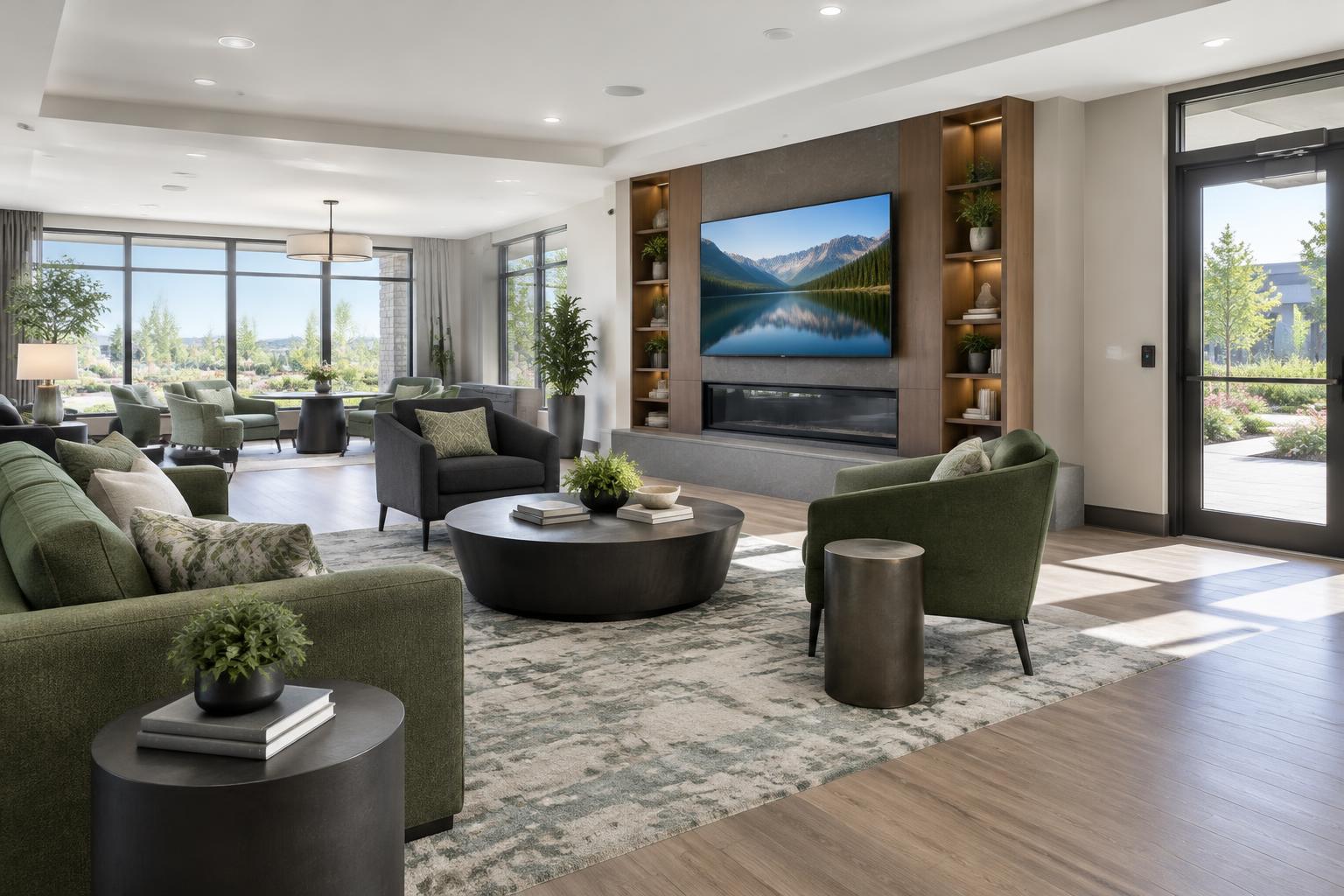
How EIG PRO Handles Technology for Senior Living, IL, AL & Hospitality
Independent living, assisted living, and hospitality properties can share the same technology systems—but they do not share the same operating needs. A resident community needs dependable everyday connectivity and thoughtful access. An assisted-living operator also needs clear coordination with its care-system providers. A hotel needs a smooth guest experience, flexible event spaces, and reliable connections behind the scenes.
EIG PRO approaches these projects as coordinated building systems: structured cabling, data networks, Wi-Fi, access control, intercoms, CCTV, commercial AV, and AV distribution, with responsibilities defined before installation starts. The goal is technology that fits the property, the people using it, and the team responsible for operating it.
Featured image is a conceptual illustration, not a photograph of an EIG PRO client property.
Independent Living: Connectivity and Amenities Without Unnecessary Complexity
For independent living (IL), we start with how residents, staff, visitors, and vendors move through the community. Resident connectivity, shared lounges, fitness spaces, dining rooms, entry points, and back-of-house areas each need a deliberate plan.
- Data and Wi-Fi: cabling and access-point locations planned around apartments, corridors, construction materials, common areas, and expected devices.
- Access and intercoms: appropriate entry permissions, visitor communication, and coordination with the selected resident credential or lock platform.
- Community AV: audio zones, displays, presentation connections, and staff-friendly controls for activity rooms, dining, and events.
- CCTV: camera views and recording requirements based on the operator’s approved security and privacy plan.
Simple day-to-day operation matters. We discuss who will administer credentials, select AV sources, respond to problems, and maintain the internet service—not just which devices will be installed.
Assisted Living: Define the Boundary Between Building Technology and Care Systems
Assisted living (AL) requires closer coordination with the operator and its specialist providers. Staff communications, resident-support systems, security, and network connections may interact, but their responsibilities must remain clear.
We coordinate the contracted cabling, connectivity, interfaces, and installation requirements with the project team. Nurse call, resident monitoring, wander-management, and other clinical or life-safety systems are not automatically included in a general low-voltage package. They require an explicitly defined scope, the appropriate specialist provider, and acceptance criteria approved by the responsible parties.
For memory-care areas, access-control behavior and any delayed-egress requirements must be designed and approved with the operator, design professionals, door-hardware supplier, fire-alarm contractor, and authority having jurisdiction. Convenience must not override lawful emergency egress.
Network segmentation, permissions, and documented interfaces can support a security plan; they do not by themselves establish HIPAA compliance or guarantee resident safety. Those obligations remain part of the operator’s broader policies and professional review.
Hotels and Hospitality: Guest-Facing Systems and Back-of-House Reliability
In hotels and lodging, we plan around both the guest experience and the staff workflow. Guest rooms, reception, restaurants, meeting rooms, outdoor amenities, and administrative areas place different demands on the infrastructure.
- Guest and staff networks: appropriate separation of guest traffic from business and security systems, coordinated with the property’s IT team and providers.
- Meeting and event AV: displays, microphones, conferencing connections, room controls, and sound coverage sized for the intended use.
- AV distribution: source routing to selected screens and audio zones, using the architecture appropriate to the property.
- Security and access: cameras, controlled staff/service entries, intercoms, and interfaces to the chosen platforms where contracted.
- Infrastructure: labeled data cabling, coordinated equipment spaces, power requirements, and testing.
Explore commercial AV, networking, and our restaurant and bar technology article. TV programming, streaming services, and music public-performance licensing are separate from equipment installation and need the appropriate commercial permissions.
Our Process: Drawings, Responsibilities, Installation, and Handoff
1. Start With the Property’s Actual Needs
We review the available plans, room uses, equipment requirements, and owner expectations. New construction, a phased renovation, and an occupied property need different installation plans. Site review and testing requirements are agreed as part of the scope.
2. Make the Responsibility Matrix Explicit
Who supplies switches and access points? Who pulls camera home-run cables? Who furnishes electrified locks, door power, and interfaces? Who owns the fiber backbone and telecom-room buildout? These questions should be answered in writing before purchasing or mobilizing.
We separate EIG PRO’s contracted work from owner-furnished equipment and other trades’ work. That avoids treating a device connection as a complete system, or counting the same cabling package twice. Optional work stays separate until accepted.
3. Coordinate the Trades Before Closing Walls
Low-voltage work depends on pathways, equipment locations, electrical power, doors, ceilings, and the construction schedule. We coordinate the contracted systems with the general contractor, electrical contractor, door-hardware supplier, owner IT team, and relevant specialists.
Door and elevator interfaces deserve particular attention. A reader, a lock, a power supply, and a life-safety release are related parts of an opening—not interchangeable responsibilities.
4. Install, Test, and Commission the Agreed Systems
Our structured cabling approach includes the labeling, terminations, and testing specified for the project. AV commissioning addresses source selection, audio zones, controls, and the intended room use. Security-system checks address the approved camera views and credential behavior.
Testing standards, certification reports, network acceptance, and third-party interfaces should be identified in the contract rather than assumed. A functioning device is not a substitute for a documented handoff.
5. Give the Operator a Clear Next Step
Handoff requirements can include agreed as-built information, equipment records, operating guidance, and staff training. We clarify who owns vendor subscriptions, software administration, internet service, and support after installation.
EIG PRO provides a one-year workmanship warranty; manufacturer warranties are passed through under their applicable terms. Ongoing service-plan coverage is separate and governed by the agreed plan. Visit EIG PRO Support for service requests.
Privacy, Accessibility, and Emergency Communications Are Planning Inputs
Camera placement, audio recording, retention, and access to footage should follow the operator’s approved privacy policies and legal review. Coverage should serve an identified purpose—not simply put a camera everywhere.
AV and controls also need consideration for the people using them. Assistive-listening requirements and accessible operation should be reviewed with the design team where applicable; the U.S. Access Board’s ADA accessibility standards are an authoritative starting point.
Pool phones, elevator communication, area-of-refuge communication, and fire-alarm interfaces must be reviewed for the specific project and jurisdiction. We do not assume a standard internet connection satisfies every emergency-communication requirement. Scope, power backup, monitoring, and approval responsibilities need to be established with the appropriate specialists and authority.
Frequently Asked Questions
Does EIG PRO handle both independent living and assisted living technology?
We can plan and deliver contracted building-technology systems for both. IL often emphasizes resident connectivity and amenities; AL requires additional coordination with the operator’s care-system providers. The proposal identifies what EIG PRO supplies, installs, integrates, and tests.
Can you work with equipment supplied by the owner or another vendor?
Yes, when the scope defines the equipment, installation responsibilities, interfaces, and acceptance requirements. Owner-furnished switches, access points, locks, or specialist systems should be identified early so pathways, power, cabling, and commissioning can be coordinated.
Are nurse call and memory-care safety systems included?
Not automatically. Those systems require an explicit scope and coordination with qualified specialist providers, the operator, and the responsible design and approval teams. A general AV, networking, or security proposal should not be read as a clinical-system package.
What should we send for a quote?
Send the location, property type, project phase, room or unit counts if known, drawings and specifications, system requirements, owner-furnished equipment list, and desired schedule. For an occupied property, include access restrictions and any planned installation phases.
Plan the Technology Around the Property
Whether you are developing independent living, assisted living, a senior community, or a hospitality property, start with the systems and responsibilities—not a generic equipment list. Request a project quote, email sales@eigpro.com, or call 877-344-7764.
For more planning background, read our BTR and senior-living technology guide, or explore structured cabling, AV over IP, CCTV, and physical access control in the Resources glossary.
Stay Updated
Get the latest insights on smart building technology, security systems, and industry trends delivered to your inbox.
Related security services
Explore how EIG PRO designs, installs and services these systems across Texas.
Security & Surveillance Systems
Access control, CCTV, intercom and monitoring designed and installed by one licensed contractor.
Learn moreAccess Control in Dallas
Card readers, mobile credentials and door hardware coordination for Dallas properties.
Learn moreSecurity Systems in Fort Worth
CCTV, LPR and gate integration for Fort Worth commercial and mixed-use buildings.
Learn moreSecurity Systems in Plano
Multifamily access control, package room and amenity surveillance across Plano.
Learn moreStructured Cabling
The Category and fiber backbone every camera and reader depends on.
Learn moreNetwork Infrastructure
PoE switching, VLANs and UPS sizing so your security system stays online.
Learn moreContinue Reading
Explore more insights and expertise from EIG PRO
Nightclub, Concert & Venue Technology in Texas: The Low-Voltage Backbone Behind the Show
Nightclubs, concert halls, and live music venues run on far more than the stage rig. Here is the low-voltage infrastructure — cabling, networking, security, and commercial AV — that keeps Texas venues open, safe, and sold out.
Restaurant & Bar Technology Services: AV, Wi-Fi, Networks & Security
Explore EIG PRO restaurant and bar services: commercial AV, multi-screen distribution, sound, networks, guest Wi-Fi, data cabling, CCTV, and access control.
Conference Room & Corporate AV Build-Outs: Crestron, Biamp, QSC, RTI, Dante & AV-over-IP in Texas
From huddle rooms to auditoriums — Microsoft Teams Rooms, Zoom, Webex, BYOD, Crestron, Biamp, QSC, RTI, Dante and AV-over-IP. Here is how EIG PRO designs, builds and commissions corporate AV across Texas.
Get a free security consultation
Access control, CCTV and networking guidance from a licensed Texas low-voltage contractor. No pressure, no obligation.