
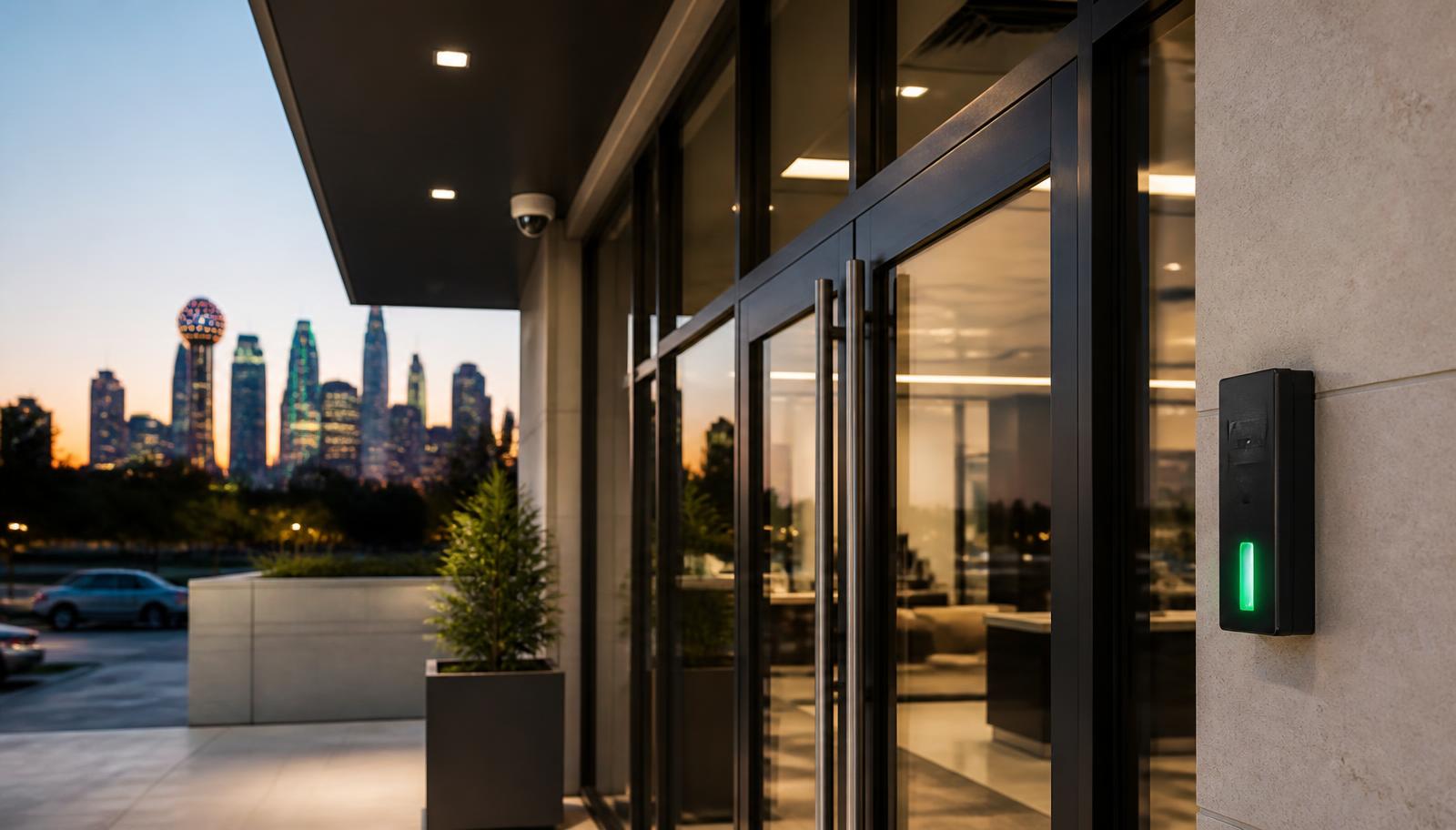
Access Control & CCTV in Texas: The 2026 Guide to Securing Commercial and Multifamily Properties
Security is the one low-voltage system every occupant notices — usually at the worst possible moment. A reader that fails on a 100-degree Dallas afternoon, a camera aimed at a parking bumper instead of a license plate, a stair door that free-egresses into an unmonitored alley. In 2026, across DFW, Houston and Austin, the buildings that get security right do it in preconstruction, not punch list. Here is how EIG PRO designs and installs access control and CCTV for Texas commercial and multifamily properties.
1. Access control starts at the door schedule, not the head-end
The single most common failure we see on Texas projects is a security scope written before anyone reconciled it against the architectural door schedule. Every controlled opening needs four things coordinated across three trades:
- Electrified hardware — mag lock, electric strike, or electrified mortise lock, specified by Div 08 but powered by Div 28.
- Power transfer — electric hinge or door loop, ordered with the frame, not field-retrofitted.
- Position and egress devices — door position switch, request-to-exit, and where required, a delayed-egress or fail-safe path.
- Pathway — conduit and back-boxes stubbed above ceiling before drywall closes.
Miss the power transfer at frame order and you are coring a fire-rated frame in the field. That is a change order every time.
2. Fail-safe vs. fail-secure: a life-safety decision, not a preference
Under the IBC and the Texas amendments most DFW jurisdictions enforce, egress can never depend on power or a credential. Practically:
- Fail-safe (unlocks on power loss) for stair doors, mag-locked openings, and anything in a required egress path.
- Fail-secure (stays locked on power loss) for perimeter entries, IDF/MDF rooms, mail rooms, and storage where free egress is preserved by the lever.
- Fire alarm interface — every mag lock ties to the FACP relay. Plan the interface early; the AHJ will test it at final.
We also coordinate the pieces the code cares about but budgets forget: area-of-refuge communication and the pool and elevator phone lines Texas requires. Those fall under our security systems scope.
3. CCTV: design for evidence, not for coverage counts
Owners often ask for a camera count. The right question is what each camera must prove. We design to purpose:
- Identification (faces at entries, leasing offices, package rooms) — tighter field of view, higher pixel density on target.
- License plate capture (garage ramps, gate lanes) — a dedicated LPR-oriented camera at plate height and angle, not a corner dome hoping for the best.
- Overview (amenity decks, pool, corridors, dumpster enclosures) — multi-sensor or wide dome with motion-driven retention.
In Texas that also means designing for heat and glare: west-facing exteriors need IR cut, true WDR, and housings rated for the sun load. A camera that washes out at 6 p.m. in July is not a camera.
Retention, bandwidth and storage
Most Texas multifamily owners land on 30 days of retention; commercial and school clients often require 30 to 90. Smart codec plus motion-based recording typically cuts storage 40 to 60 percent versus continuous. Size the switch and UPS accordingly — PoE budget and battery runtime are where value-engineered systems quietly break.
4. Cloud, on-prem, or hybrid
| Model | Best fit | Trade-off |
|---|---|---|
| Cloud-managed access and video | Multi-site owners, lean on-site staff, mobile credentials | Ongoing subscription per door / per camera |
| On-prem server and VMS | Schools, industrial, high camera counts, strict data policies | Requires IT ownership, patching, hardware refresh |
| Hybrid | Local recording with cloud access and alerting | Two systems to license and maintain |
For multifamily in DFW, cloud access control with mobile credentials has become the default — property managers can revoke a resident credential at move-out from a phone, which eliminates the rekey and lost-fob cycle that used to eat the operations budget.
5. What it costs in Texas in 2026
Budgeting ranges we see on North Texas projects, installed, excluding owner subscription fees:
- Controlled opening (access control, per door): roughly $2,200 – $4,000 depending on hardware, mag vs. strike, and pathway length.
- Interior fixed dome camera: roughly $900 – $1,600 installed.
- Exterior, multi-sensor or LPR camera: roughly $1,800 – $3,500 installed.
- Head-end (NVR, storage, PoE switching, UPS, rack): typically $12,000 – $45,000 depending on channel count and retention.
Treat these as planning ranges, not a quote — garage structures, long conduit runs, and prevailing-wage jobs move the number. For a building-level view of Division 27 and 28 budgeting, read our cost-per-door guide.
6. Five misses that blow the security budget
- No conduit at exterior openings. Retrofitting a reader on a finished masonry facade costs more than the reader.
- Undersized PoE and UPS. Cameras brown out during a storm and the owner loses the exact footage they needed.
- Gate and garage coordination left out. Vehicle gates, call boxes, LPR and loop detectors involve a fourth vendor. Assign it in preconstruction.
- Credential strategy decided at turnover. Mobile vs. fob vs. card changes reader hardware. Decide before you order.
- No commissioning plan. Every door tested against the fire alarm, every camera view signed off by the owner, retention verified in writing.
Where EIG PRO fits
We are a licensed Texas low-voltage contractor (License #B28642601) headquartered in Wylie, serving Dallas, Fort Worth, Plano, Frisco, McKinney, Arlington and the broader DFW metroplex. We self-perform structured cabling, access control, video surveillance and network infrastructure, so the door hardware, the pathway, the switch and the camera all answer to one contractor — which is why our punch lists are short.
Planning a new build or a retrofit? Request a security systems budget and we will walk your door schedule and camera plan with you before it becomes a change order.
City guides
- Access Control & CCTV in Dallas — high-rise lobbies, garage plate capture, permits.
- Access Control & CCTV in Fort Worth — vehicle gates, adaptive reuse, industrial perimeters.
- Access Control & CCTV in Plano — mobile credentials, package rooms, corporate campuses.
Stay Updated
Get the latest insights on smart building technology, security systems, and industry trends delivered to your inbox.
Related security services
Explore how EIG PRO designs, installs and services these systems across Texas.
Security & Surveillance Systems
Access control, CCTV, intercom and monitoring designed and installed by one licensed contractor.
Learn moreAccess Control in Dallas
Card readers, mobile credentials and door hardware coordination for Dallas properties.
Learn moreSecurity Systems in Fort Worth
CCTV, LPR and gate integration for Fort Worth commercial and mixed-use buildings.
Learn moreSecurity Systems in Plano
Multifamily access control, package room and amenity surveillance across Plano.
Learn moreStructured Cabling
The Category and fiber backbone every camera and reader depends on.
Learn moreNetwork Infrastructure
PoE switching, VLANs and UPS sizing so your security system stays online.
Learn moreContinue Reading
Explore more insights and expertise from EIG PRO

Access Control & CCTV in Dallas: What Downtown and Uptown Buildings Get Wrong
A Dallas-specific look at access control and video surveillance — high-rise lobbies, tenant floors, garage LPR, permitting through the City of Dallas, and what owners in Uptown, Deep Ellum and the Design District should budget in 2026.
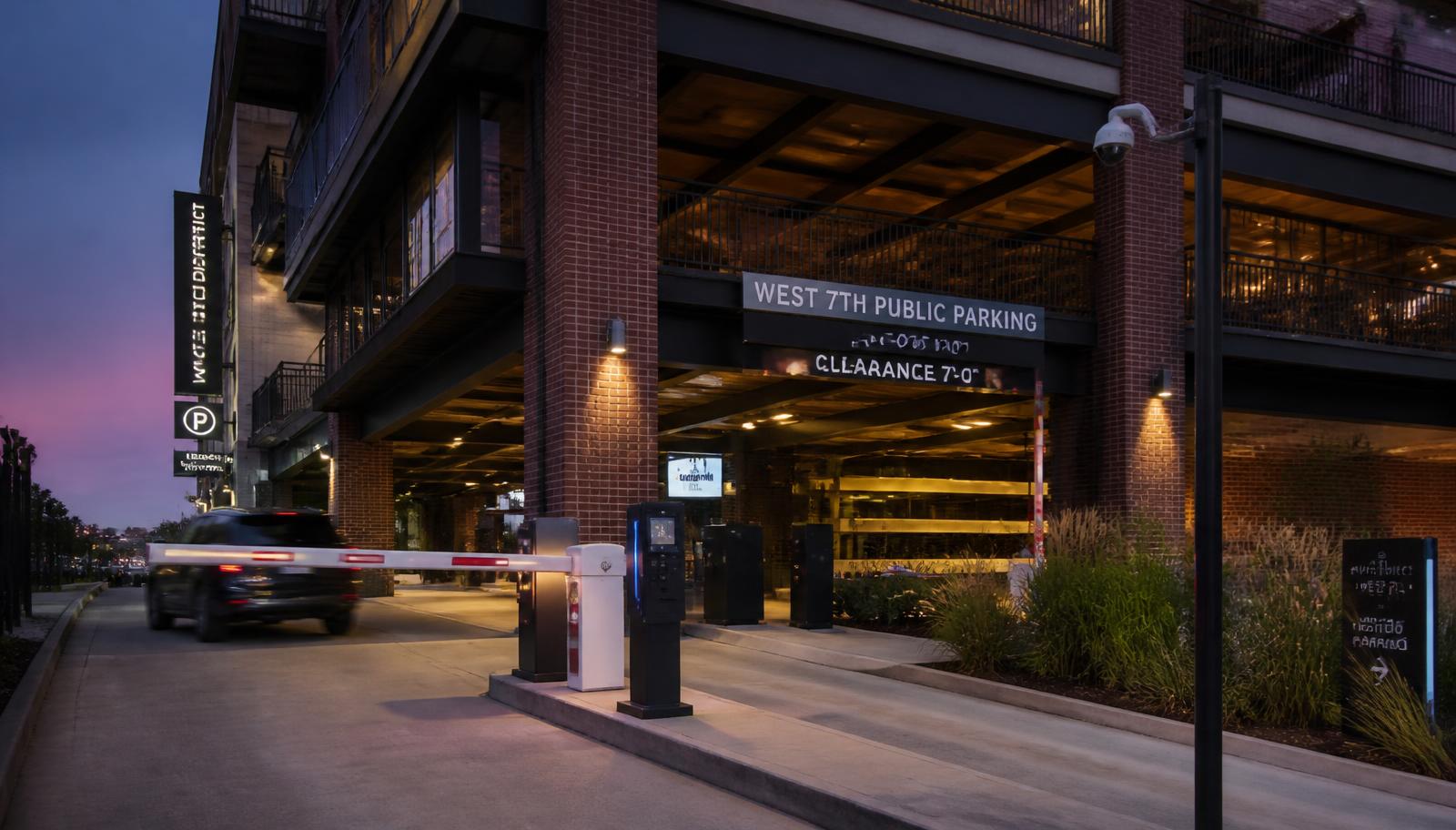
Access Control & CCTV in Fort Worth: Garages, Gates and Mixed-Use Done Right
Fort Worth-focused guidance on access control and video surveillance for mixed-use, industrial and multifamily properties — vehicle gates, LPR, adaptive reuse pathways, and 2026 installed costs.
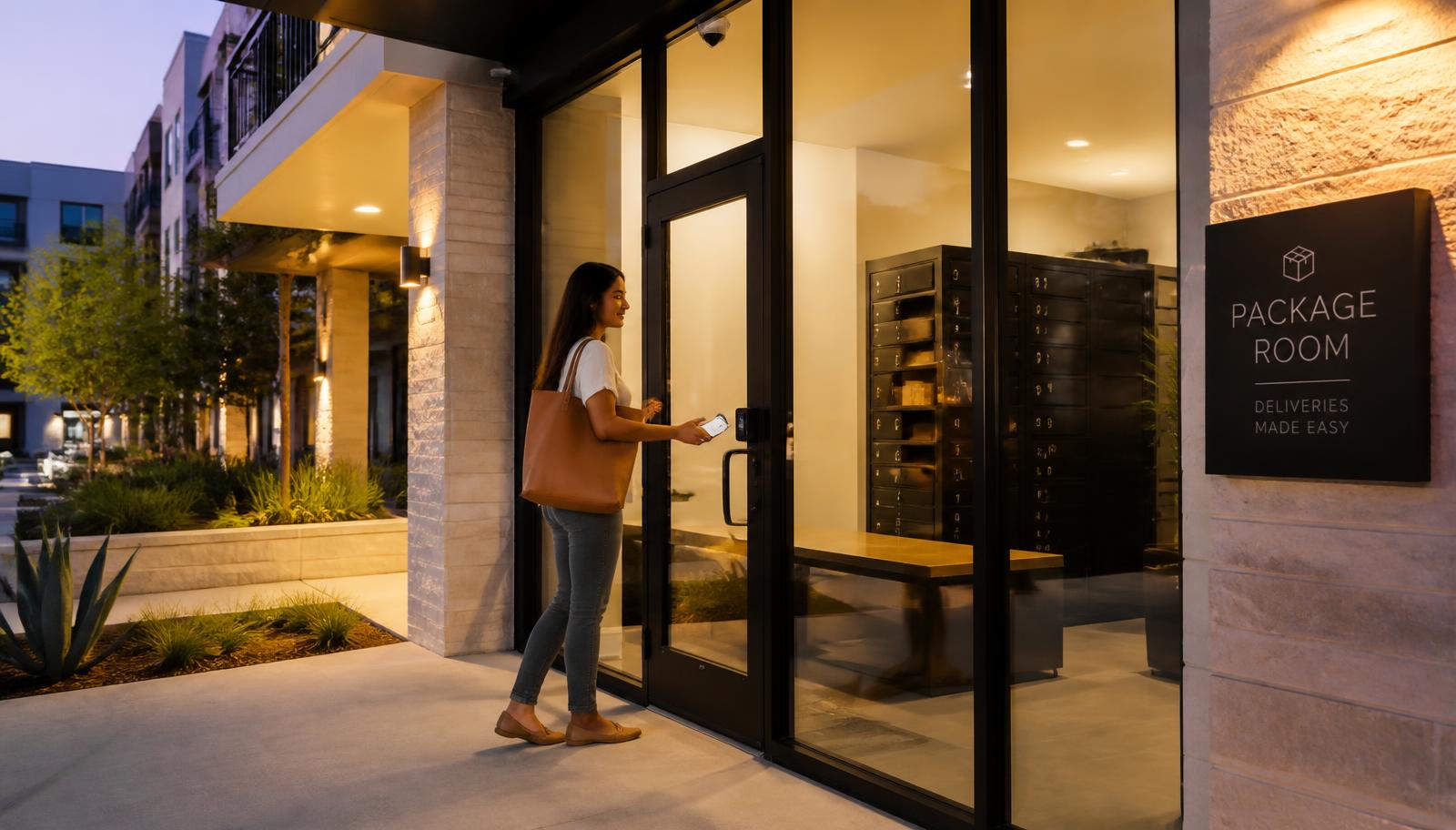
Access Control & CCTV in Plano: Multifamily and Corporate Campus Security
How Plano owners should design access control and CCTV in 2026 — mobile credentials for Class A multifamily, package room and amenity coverage, corporate campus badging, and real installed costs.
Get a free security consultation
Access control, CCTV and networking guidance from a licensed Texas low-voltage contractor. No pressure, no obligation.